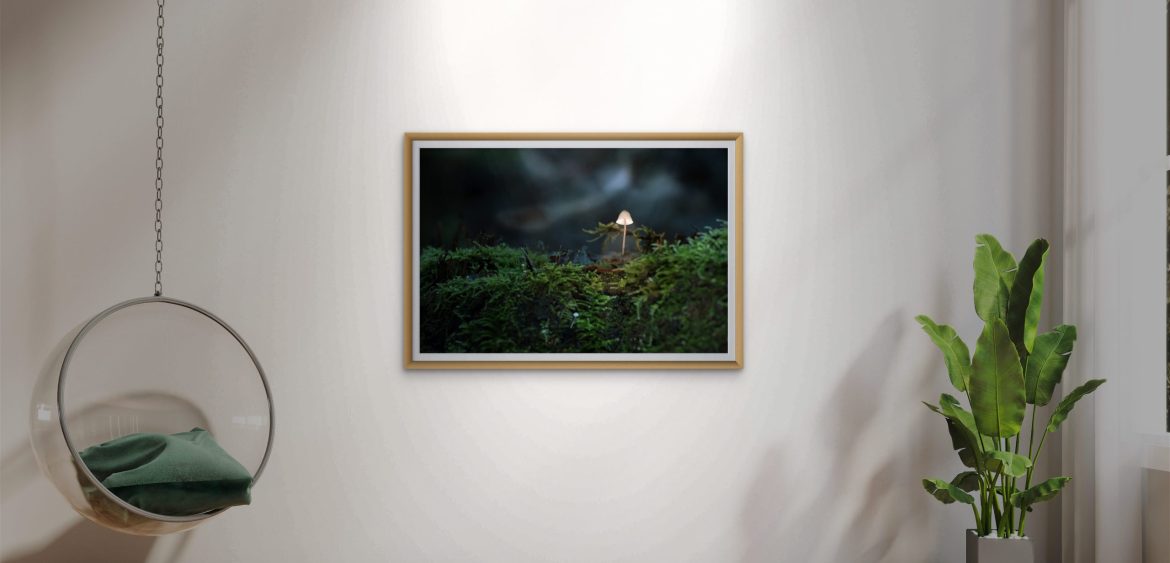

Mushroom photography prints entered my home the same way they enter the forest: softly, close to the ground, asking for unhurried attention. The first time I placed one on a bright wall, the room did not change suddenly. It breathed more slowly. Dark green and blue tones carried the quiet of moss and shadow, and a single delicate form rose just enough to hold the gaze without asking for it.
I return to the forest floor because it teaches me how to see again. Standing trees speak with a broad voice; ground-level life prefers a whisper. When I photograph mushrooms, I am not collecting trophies. I am listening for the rhythm between moisture and light, between texture and distance, between what reveals itself and what chooses to remain hidden.
At home, this language becomes part of daily life. A print is not a window pretending to be a forest. It is a presence that remembers the air of that place and shares it carefully. Over time, it changes the way a room receives morning light, the way an afternoon pause feels, the way a hallway becomes a small conversation rather than a passage.
This is why I live with these images. They offer a simple invitation: come closer, look more slowly, let small forms speak. In return, a room learns to be quiet without becoming empty.
When I lower my gaze to the forest floor, quiet gathers around small forms until they begin to speak.
1. Lowering Attention To The Ground
When I walk through a forest, I do not begin by looking up. I begin by adjusting my pace until each step stops sounding like a step. Moss appears first, then a soft gradient of shadow, then the quiet of moisture held near the soil. Only when my attention settles do small forms start to rise from the green—mushrooms, pale or rust-colored, making space within space.
This is where mushroom photography begins for me: not in the frame, but in the moment when the body accepts a slower rhythm. The forest floor has its own atmosphere, compact and intimate. Details are not scattered; they are contained. Every inch can hold a story if I am willing to spend time with it.
In prints, that intimacy becomes a way of shaping interior space. A room often benefits from images that do not announce themselves from the doorway. The forest floor teaches restraint. It asks for closeness. It invites the eye to move gently across negative space, to consider texture before color, shadow before brightness. When I bring these photographs into a home, I want them to keep that integrity—to remain quiet and attentive, just as they were when I first noticed them.
Beauty here is not a performance. It is a slow exchange between seeing and being seen. I find that when an image respects this pace, a room relaxes into it as well.
2. A Wider Forest Inside A Room
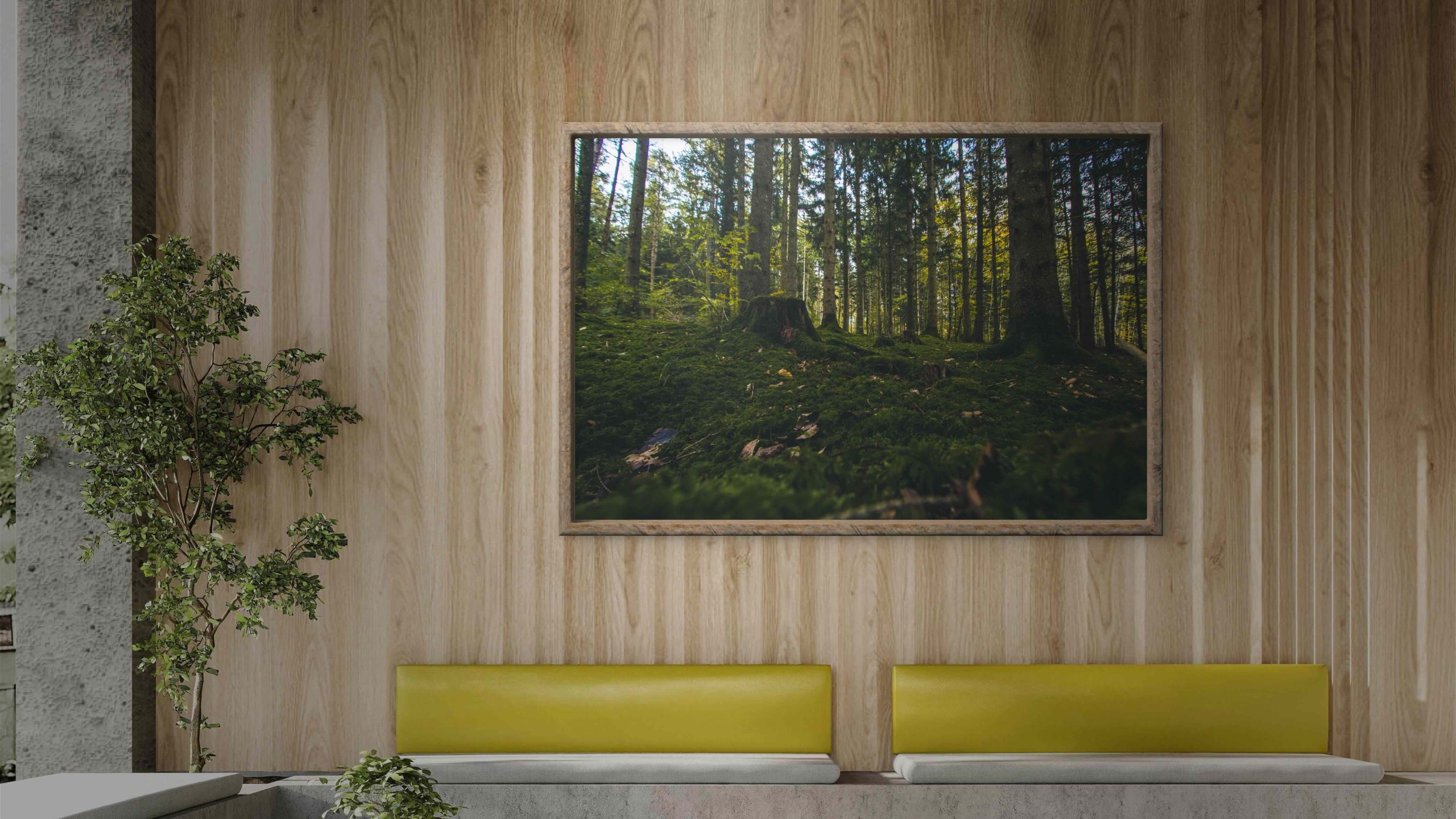
Some interiors ask for a broader breath—something that holds the sense of a place rather than a single subject. In those spaces, I turn to photographs where the mossy ground, tree trunks and filtered light create an architectural rhythm. The forest becomes a field of quiet structure: verticals, horizontals, and the soft weight of shadow connecting them.
On a warm wooden wall, those tones deepen. Wood and green speak the same language; they both remember moisture, time and touch. When a wide forest print meets natural materials, the room gains depth rather than distraction. The image is not a scene to consume. It is a horizon of calm that supports the furniture, the textures under hand, the cadence of daily rituals.
I watch how such photographs interact with light across the day. Morning makes the greens feel fresh; late afternoon draws out the low notes of shadow. A good print absorbs these changes and gives them back slowly. This is the difference between decoration and presence: one is placed; the other is lived with.
When I choose a wider forest image for a space, I think of it as an atmosphere maker. It does not lead the room. It steadies it.
3. Small Forms, Slow Seeing
Mushrooms ask for patience. They are neither rare trophies nor theatrical gestures. They are small declarations of form made possible by moisture, darkness and a precise kind of light. I kneel a lot. I wait for the background to quiet itself until a single stem lifts from moss and becomes a sentence spoken clearly.
In the frame, negative space does the quiet work. A dark blue-green field behind a pale cap holds tension without noise. Edges matter—where light lets go, where shadow begins to think. If the print feels simple, it is because most of the work has been done by removing what does not belong to the moment.
At home, these images do not shout to be noticed. They move differently. You catch them in passing, then return for a second look. A small mushroom becomes an anchor, a steadiness at eye level. The room slows near it. Over time, this quality does more for a space than spectacle ever could.
I often think of these prints as companions for quiet tasks: making tea, reading a page, tying a shoelace before leaving. They hold a silence that respects attention.

4. Green As A Quiet Tone
Green is not one color. On the forest floor, it is breath layered upon breath: velvet moss, damp leaf, light filtering through distance. In prints, these variations become a quiet tone that supports daily life. They do not compete with the room; they tone it, the way soft music can steady a morning without drawing focus.
I pay attention to how green sits among materials. Oak and walnut hold it warmly. Linen and wool soften its edge. Clay, stone and matte paint give it space to breathe. Against a bright wall, a forest print introduces depth without darkening the room; the greens gather shadow in a way that feels gentle and contained.
Color is often treated as an instant effect, but the green of the forest floor does its work slowly. It accepts light rather than reflecting it aggressively. It calms contrast. It gives space back to the eye. In a contemporary interior where lines are clean and surfaces are even, this kind of green brings a necessary softness.
5. Scale, Placement And The Whisper Of Presence
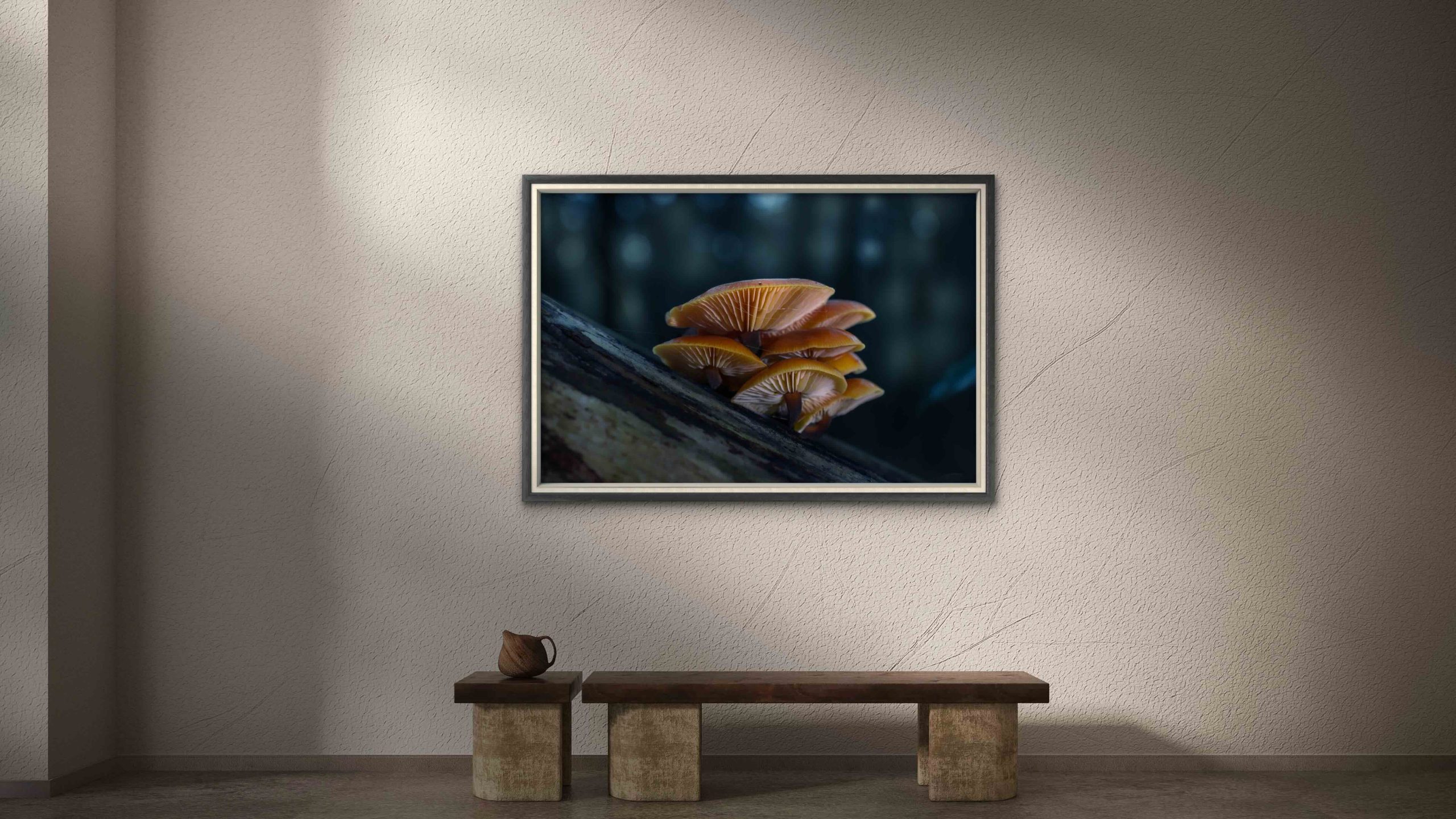
Small subjects can hold a surprising amount of space. The key is not to make them larger than life, but to let their quiet fill the right distance. When I hang a print of small orange mushrooms above a bench or sideboard, I pay attention to sightlines and pauses. The artwork should meet the eye at a calm moment in the room’s path.
Scale serves presence, not dominance. A modest print near a place where someone will naturally pause—a hallway rest, an entry, a corner with a simple bench—often carries more weight than a large piece placed where no one can spend time with it. Proximity allows discovery. You move closer and begin to notice: the soft geometry of caps, the thread of a stem, a low seam of moss.
Muted walls help these prints breathe. Even subtle texture—limewash, plaster, matte paint—makes the dark tones feel grounded. I look for a balance between negative space around the frame and the visual density of the print itself. Too tight, and the image feels cornered; too loose, and it loses its invitation to step nearer.
In practice, I hang with a simple rule: let the artwork whisper and trust that the room will hear it.
6. A Print That Listens Back
The most rewarding part of living with mushroom photography happens long after the print is on the wall. A good image begins to listen. It reflects the room’s routine—steam from a morning cup, a book left open, the way daylight shifts across shelves. The print does not demand attention; it holds it gently and gives it back when you return.
I have a quiet fondness for how mist sits around a single mushroom in certain images. That softness does something domestic; it makes room for rest. Above a wooden sideboard or near a reading chair, such a print gathers the edges of a day and keeps them from fraying. It becomes part of the home’s low hum, that place where objects and habits learn to trust each other.
Light helps. Indirect daylight across the surface reveals the depth of shadow and the thinness of a cap’s edge. In the evening, a warm lamp nearby brings the greens into a low register and the image settles, almost like a person lowering their voice. I want prints to meet a room where it lives, not where it performs.
Over months and years, this is how a photograph justifies its presence: not with spectacle, but with constancy.

7. From Decoration To Relationship
I am often asked about the difference between decorative nature imagery and fine art photography. For me, it begins with intention and ends with how the image behaves once it enters a room. Decoration entertains from a distance; fine art invites a relationship over time.
When I photograph mushrooms, I work toward a clarity that is not loud. The composition needs room to breathe. Shadows need depth rather than darkness. Detail should serve feeling. If an image is successful, you sense the air between elements—the pause before a stem rises, the damp quiet holding the scene together.
In a home, this difference becomes practical. Relationships require attention but do not insist on it. A print that carries the forest floor’s restraint helps a room find the same. It continues a conversation rather than trying to finish it. This is the spirit behind my Quiet Nature work: to make images that remain open.
When I watch someone encounter these prints, what stays with me is not a first reaction, but the way they return for another look. That is relationship.
8. Care, Light And The Passage Of Time
Living with a photograph is simple if you treat it like a guest you respect. Soft, indirect light is enough. Avoid long hours of direct sun where possible; the forest floor was born under a canopy, and it appreciates a similar gentleness indoors. If glare appears, a small shift in angle or a different lamp placement usually resolves it.
Framing has its own quiet role. Natural wood grounds the greens; a thin black frame brings a contemporary line that holds the shadows. A mat can introduce breathing room around the image, but I remain attentive to proportion—the mat should not shout louder than the subject. Clean with care, and dust with a soft cloth. Prints do not ask for much.
I notice that certain rooms welcome this work easily: reading corners, bedrooms, places of transit where time briefly slows. In these spaces, a mushroom photograph becomes not only visual company but a reminder to pass through more slowly. The image does not change the room overnight. It guides the room over time.
This is how I hope my photographs live: by understanding the pace of a home and adding a degree of softness to it, day after day.
See the Artwork on Your Own Wall
Choosing the right print size can be difficult when viewing artwork online. With the Wall Preview Tool ,you can upload a photo of your room and visualize the artwork directly on your wall. This makes it easier to compare sizes, evaluate placement, and select the print that best fits your space.
FAQ
|
What makes mushroom photography prints different from decorative nature posters? Intention and time. My prints grow from slow observation at ground level, where light, moisture and silence shape the image. They are composed to breathe in a room, with depth in the shadows and space for small forms to speak. Decoration entertains quickly; fine art builds a relationship quietly over years. |
|
Where in a home do these prints feel most at ease? They settle well where attention naturally slows: reading corners, bedrooms, entry benches, quiet hallways and above sideboards. Near places of daily ritual—making tea, taking off a coat, choosing a book—the images invite close looking without interrupting the rhythm of the room. |
|
Will the darker forest tones make a small room feel heavy? Not if they are balanced with space. Dark greens and soft shadows can actually deepen a small room when the print has negative space and the wall around it remains calm. Natural materials—wood, linen, matte paint—help the tones feel grounded rather than heavy. |
|
How should I choose size and framing for a subtle subject like mushrooms? Let distance guide size. If you will stand close, a modest print preserves intimacy; if you will view from across a room, choose a larger scale with breathing room around it. Natural wood frames and thin black profiles both suit forest tones. A light mat can add space, but keep proportions quiet. |
|
How do I care for a fine art print at home? Keep it out of prolonged direct sun, dust the frame gently and avoid harsh cleaners on glazing. If reflections appear, adjust placement or lighting rather than forcing brightness on the image. Prints appreciate a stable environment—much like the forest floor where the photograph began. |
Final Thought
When I kneel among moss and shadow, time becomes easier to hear. The forest floor teaches me that small forms can carry the weight of a place if I am patient enough to see them. Living with these photographs continues that lesson at home. They do not promise transformation; they offer company. If, on a quiet afternoon, you find yourself pausing by a pale stem rising from green, you may notice that the room is pausing with you. That is enough.
If these reflections stay with you, the Quiet Nature collection continues the conversation—images shaped by moss, light and unhurried attention.