
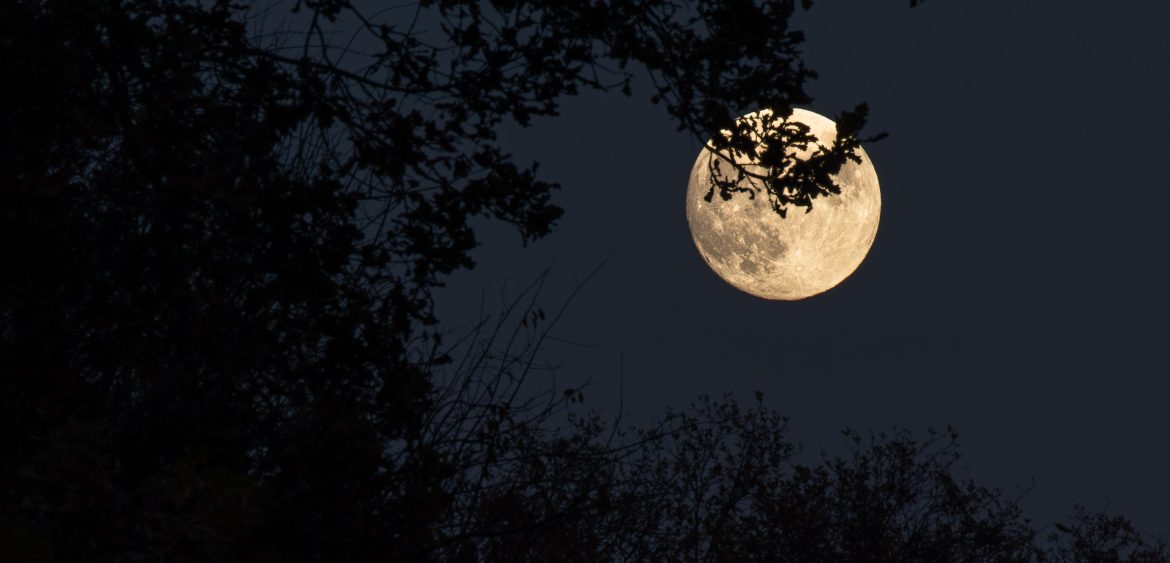

Dark branches overlap a warm, nearly circular Moon against a blue-grey sky. Foliage enters from the left and above, while more vegetation crosses the lower composition. The opening photograph gives the lunar surface a rough, irregular frame: before the eye reaches the Moon, it encounters the shapes of things nearer to the observer. Those interruptions are essential to the picture’s structure.
In The Moon Between Presence and Disappearance, part of Mauro Roncoroni’s Between Worlds collection, fine art moon photography becomes a study of relationships within the frame. An aircraft and its contrails, broad clouds and a bird each change how the celestial subject is perceived. A partial solar eclipse introduces a deliberate counterpoint, showing the Sun partly occulted rather than the Moon as a visible disc.
The sequence moves through different kinds of encounter without establishing a shared place or observing session. Its continuity belongs to the photographs: repeated rounded forms, changing skies and the meeting of distinct textures on a flat surface. Each image asks how much of a subject must remain visible for it to hold a composition together.
A shape becomes familiar through its outline, but what crosses that outline can teach us to look again.
Branches Give the Moon a Terrestrial Frame
The opening photograph places two kinds of detail together. The Moon has a broadly rounded contour and a visible surface; the branches divide into uneven lines, accompanied by patches of foliage. Where their silhouettes overlap the lunar disc, the eye can distinguish the nearer form without losing its sense of the larger shape behind it. The overlap creates depth through a direct visual relationship. Nothing needs to be added to explain that one element stands between the observer and another.
The vegetation also prevents the surrounding sky from becoming a neutral backdrop. Its entry from several edges makes the view feel bounded by the terrestrial scene. The Moon is encountered through an opening rather than presented alone. This gives the photograph a particular intimacy of scale: the distant subject shares a composition with forms whose branching structure is familiar.
As a reading of the image, that arrangement offers a starting point for the series. Visibility is already partial, even where the Moon remains readily recognisable. The branches do not erase it. They make the act of seeing it more specific, giving the eye several routes towards the same luminous centre of attention.
An Aircraft Draws a Direction Across the Sky
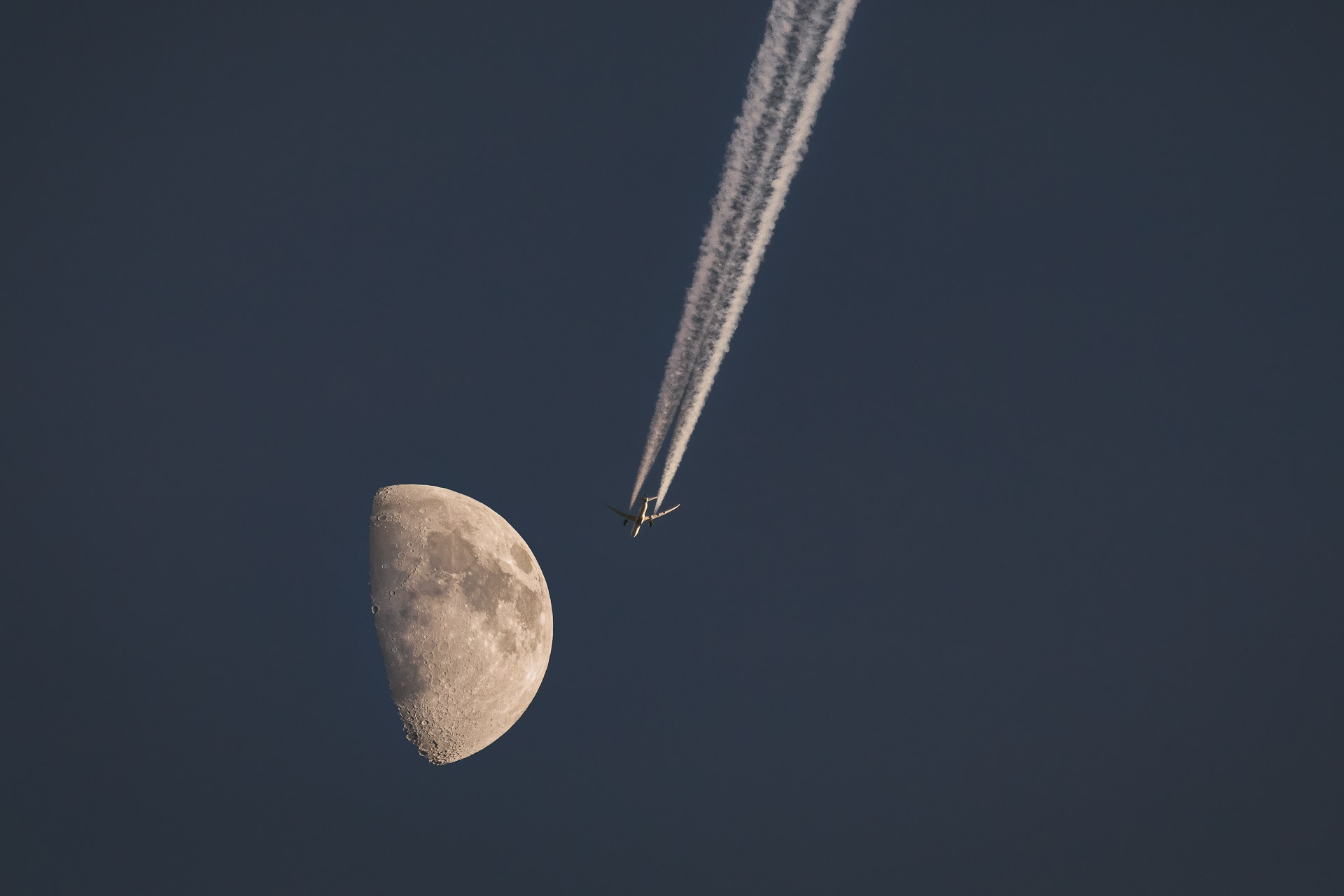
In the first body photograph, a partially illuminated Moon occupies the lower-left area of a blue-grey sky. An aircraft appears above and to its right, accompanied by two prominent contrails extending diagonally towards the upper edge. The arrangement brings the subjects close on the picture plane without implying that they are physically near one another. Their apparent meeting belongs to the composition, where separate scales can be gathered into a single view.
The contrails give this image its strongest directional element. The eye can follow their diagonal towards the aircraft, then move across the intervening sky to the Moon. That route differs from the branching paths of the opening photograph. Here, a more sustained line sets the surrounding space in motion. The aircraft supplies a compact point of attention, while its trails occupy a larger area and give its passage a visible extension. Against them, the surface markings of the Moon offer another kind of detail, held within a bounded form.
This juxtaposition can be read as a meeting of human movement and a celestial presence, but its interest lies in the precise separation of the elements. The sky between them matters as much as their apparent closeness. It allows each to remain legible while the diagonal links their positions. The image makes room for both a route through the frame and a place where the gaze can settle. Looking back and forth between those two structures is more rewarding than treating the photograph simply as an unusual conjunction.
The Partial Solar Eclipse Changes the Subject
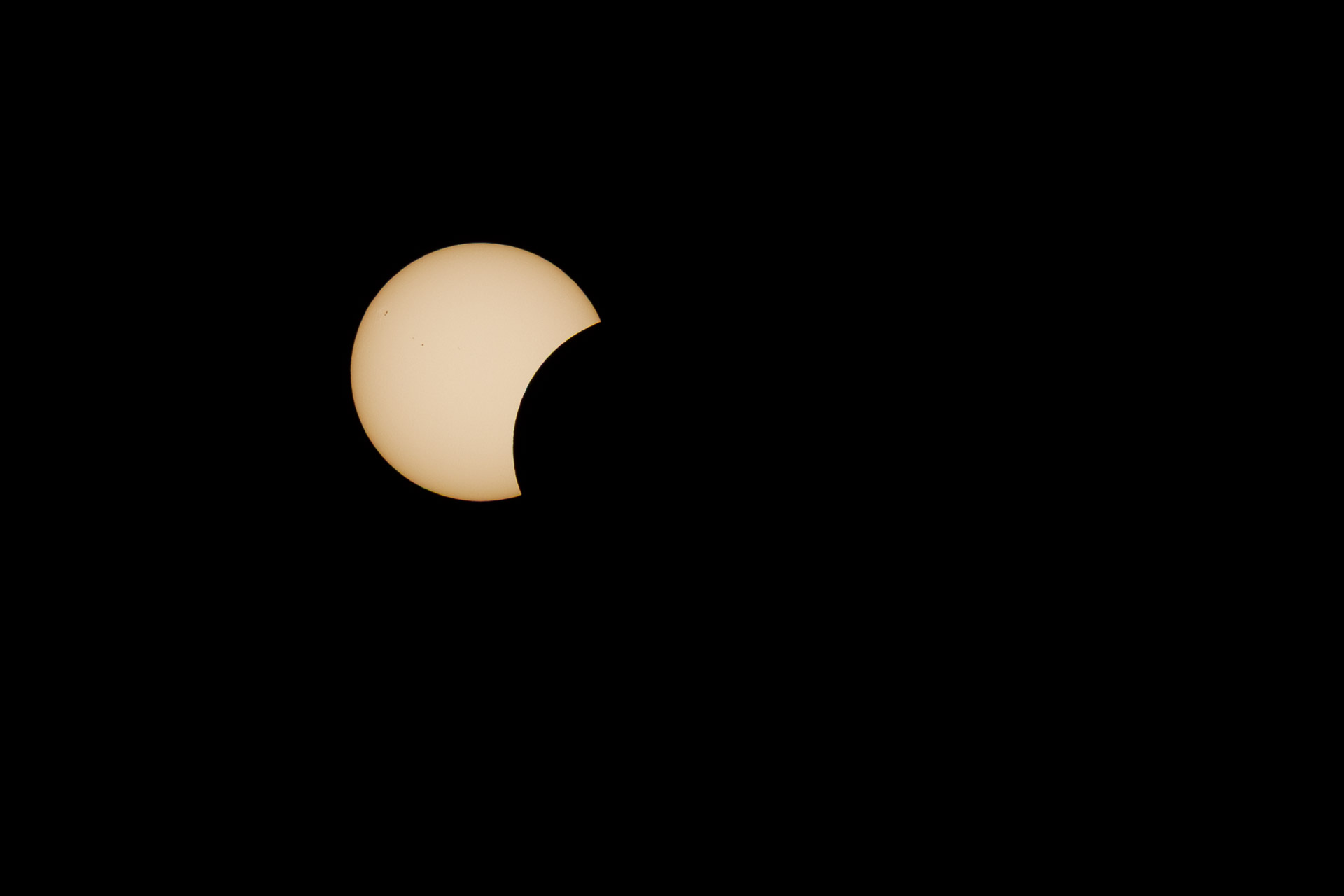
The next photograph presents a pale, warm solar disc against black. A curved dark overlap obscures part of its lower-right side: this is the Sun partly occulted during a partial solar eclipse, not a lunar phase. Small dark marks are also visible on the bright disc. They remain details of the supplied description, without requiring an identification to contribute to the photograph’s texture. The principal event for the eye is the altered outer shape.
After the aircraft photograph, the change in composition is pronounced. Diagonal trails and open blue-grey sky give way to a much more concentrated relationship between light and darkness. The curved interruption is part of what makes the bright form recognisable as an eclipse. It is not an object passing beside the disc, as the aircraft appears beside the Moon. It cuts into the visible area of the Sun and changes the shape available to the viewer. The surrounding black gives that boundary particular weight.
Within this sequence, the image offers a way to consider the Moon through the interruption of sunlight rather than through its own visible surface. That is both a clear change of subject and a productive visual connection. Presence can be read through an effect on another form. The photograph needs no additional narrative to sustain this idea: the curved absence supplies its own compositional fact. Its placement also prevents the essay from becoming a succession of similar lunar portraits, requiring the viewer to identify the bright disc anew.
Clouds Make Visibility Gradual
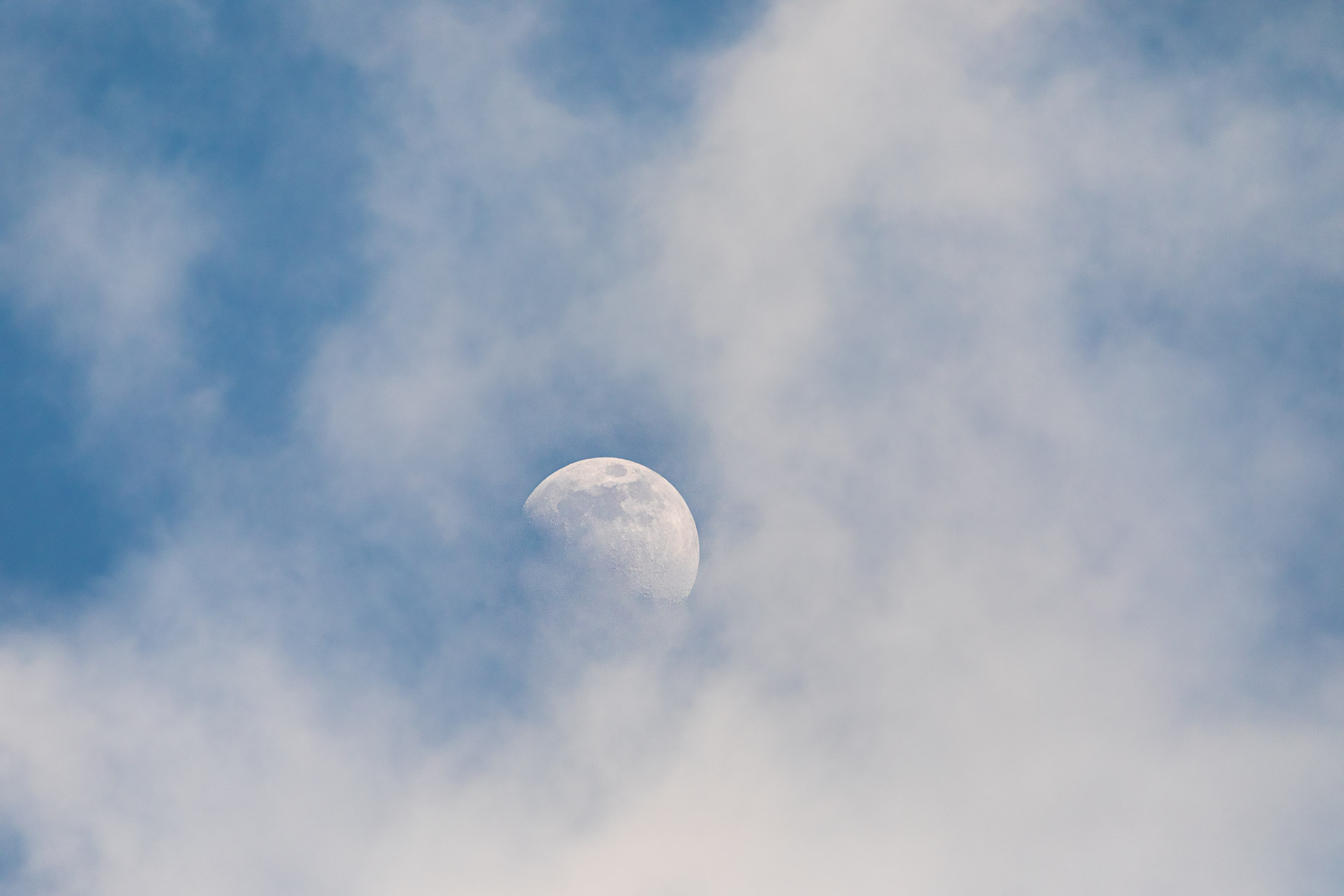
The third body image returns to the Moon, low and slightly left of centre in a blue sky crossed by broad, soft white clouds. Parts of its outline and surface are less clear beneath the cloud cover. Compared with the eclipse photograph, the composition is brighter and the divisions between its elements are less emphatic. The Moon remains a distinct subject, but its visibility varies across its form rather than depending on a single clearly defined interruption.
Clouds change the viewer’s work. In the eclipse image, attention gathers at the meeting of the bright solar disc and the curved darkness. Here, the eye has to negotiate differences in clarity across a wider field. A partially veiled edge can still suggest the continuation of a rounded shape, while reduced surface detail draws attention to the conditions through which it is seen. Recognition persists even when description becomes less exact. The Moon’s place in the picture is maintained by what remains visible and by the coherence of its overall form.
The broad cloud shapes also bring the surrounding sky into a more active relationship with the subject. They are not merely empty space around a disc; they share its area and soften its separation from the rest of the photograph. As an interpretation, the image suggests that concealment need not operate as a complete barrier. It can be uneven and gradual. This gives the sequence a different visual pace, encouraging the gaze to move across the clouds as well as towards the Moon.
A Bird Shares the Frame
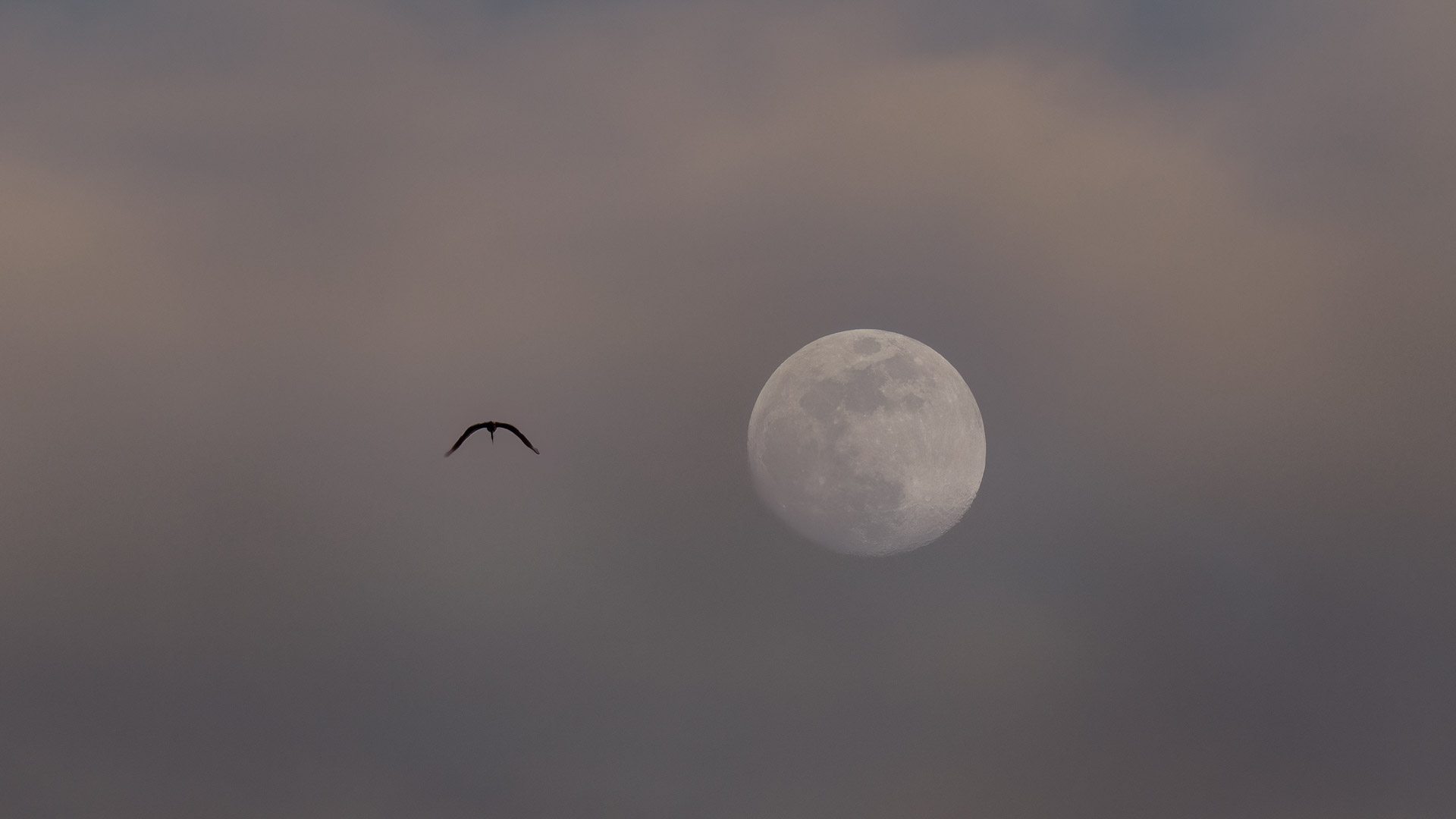
In the final body photograph, a dark bird silhouette appears to the left of a pale, largely illuminated Moon. Its wings are extended. Muted grey, mauve and warm tones fill the sky, with diffuse cloud or haze reducing the sharp separation associated with the eclipse image. The bird and Moon are both legible within this softer setting, yet they hold attention differently: one through a compact, irregular silhouette, the other through a broad illuminated form.
The bird introduces a sense of passing movement without the long directional marks seen beside the aircraft. Its extended wings make flight visible in the shape of the body itself. No species identification is needed for this relationship to work. Nor does the photograph establish a path beyond the frame. What it offers is a brief coexistence within the composition, with an interval of sky allowing the two subjects to be read separately and together. The Moon appears steady by comparison, a visual impression rather than a claim that the photograph records duration.
This closing image recalls the opening branches through the contrast between a dark terrestrial form and a pale lunar surface. The relationship has changed, however. The branches overlap and frame the Moon; the bird occupies a neighbouring position. It neither screens the disc nor provides a fixed border around it. The composition therefore ends with a more open arrangement, in which the viewer can move between two forms without following an enclosing edge or a continuous trail. Their shared frame is enough.
Reading the Sequence Through Its Edges
Seen together, the photographs organise attention through several kinds of boundary. Branches cross a rounded disc. Contrails extend a line through the sky. The eclipse alters the outline of the Sun. Clouds make the Moon’s edges less certain, and the bird supplies a separate silhouette nearby. Each boundary gives the eye different information about overlap, movement or separation. This is what makes the sequence coherent without making its images interchangeable.
The order is best understood as an editorial progression rather than a record of consecutive events. No common location, date or observing session is established. Moving from one photograph to the next changes the terms of looking: enclosed space becomes directional, then concentrated around an interrupted disc, then more diffuse and finally shared by two distinct forms. The sequence allows these visual differences to carry the argument.
Within Between Worlds, the title can therefore be read quite concretely. The photographs bring terrestrial elements and celestial subjects into the same field of vision while preserving their differences. Their connection is made through framing. The resulting pictures invite close comparison, especially where a familiar shape remains recognisable despite changes in what surrounds or obscures it.
FAQ
|
What connects the photographs in The Moon Between Presence and Disappearance? The sequence connects celestial subjects with elements that frame, cross or soften the view: branches, aircraft contrails, clouds and a bird. Its continuity comes from composition rather than a documented shared occasion. Rounded forms recur, while changes in outline, texture and surrounding space give each photograph a distinct role. |
|
Is the bright disc in the eclipse photograph the Moon? No. The second body photograph shows the Sun partly occulted during a partial solar eclipse. A curved dark overlap obscures its lower-right side. Within the essay, this image is a counterpoint to the lunar photographs: the Moon is considered through the interruption of sunlight, rather than through a visible lunar disc. |
|
Does the aircraft photograph show physical proximity to the Moon? The aircraft and Moon appear near one another within the frame, but that arrangement does not imply physical proximity. The photograph brings them together visually. Its two prominent contrails establish a diagonal direction, while the Moon’s position in the lower-left area creates a separate point of attention across the sky. |
|
Why are the branches and clouds important to the essay? They produce different kinds of partial visibility. The branches create defined silhouettes that overlap the Moon and frame the opening view. Clouds reduce the clarity of parts of its outline and surface more gradually. Comparing these images reveals how obstruction can shape a photograph without making its principal subject unrecognisable. |
|
How should the final bird photograph be read within the sequence? The bird introduces flight through its extended wings and dark silhouette, beside a pale Moon. It recalls the terrestrial forms in the opening image but does not frame or overlap the lunar disc. As a closing image, it brings the essay towards coexistence within the frame rather than another act of concealment. |
Final Thought
The opening branches establish a useful way to read the whole series: look at the Moon, then look at what complicates the view. A contrail introduces direction; an eclipse changes the outline of the Sun; clouds soften recognition; a bird gives the final frame a passing companion. These elements do more than surround a central subject. They determine how that subject becomes visible within each photograph. Across Between Worlds, presence is never simply a matter of occupying the frame. It takes form through edges, overlaps, intervals and the particular character of the sky around it.
Return to the opening photograph and follow the sequence once more, looking first at each bright disc, then at the branches, trails, clouds and wings that change its place in the picture.


